
An extrusion laminating machine bonds two packaging materials, such as printed film and aluminum foil, using a layer of molten resin from a T-die. The extruder configuration on the machine determines the laminate structure you can create, its bond strength, and the resin cost per meter.
Flexible packaging plants use three configurations: single extrusion, co-extrusion, and tandem extrusion. The right choice depends on your target packaging structure and the resin you use.
What is Extrusion Lamination?
Extrusion lamination, or sandwich lamination, uses molten resin as both an adhesive and a packaging layer. The extruder melts a resin such as LDPE or PP, and then the T-die forms it into a thin curtain the width of the web. The resin curtain drops between the primary material and the sandwich material, and all three meet at the nip between the chill roll and the pressure roll.
Extrusion coating uses the same process but with a single substrate. Molten resin coats one material without a second material placed on top of it.
Pipe, profile, cable, and bottle extrusion machines use extruders on the same principle, but they operate in different machine lines and produce rigid or hollow products. In flexible packaging, the extruder works as an integral part of the laminating machine.
Main Units of an Extrusion Laminating Machine
The T-die sits directly above the V-shaped gap between the cooling roll and the silicone roll, with an air gap of about 150 mm on Intermac machines. The cooling roll speed also regulates the resin layer thickness, as the roll pulls the resin curtain from the T-die. A mirror chrome cooling roll produces a glossy surface, while a matte cooling roll produces a matte finish. Some lines add a corona treater for the film, or an ozone treater on the resin curtain, to strengthen the bond to aluminum foil.
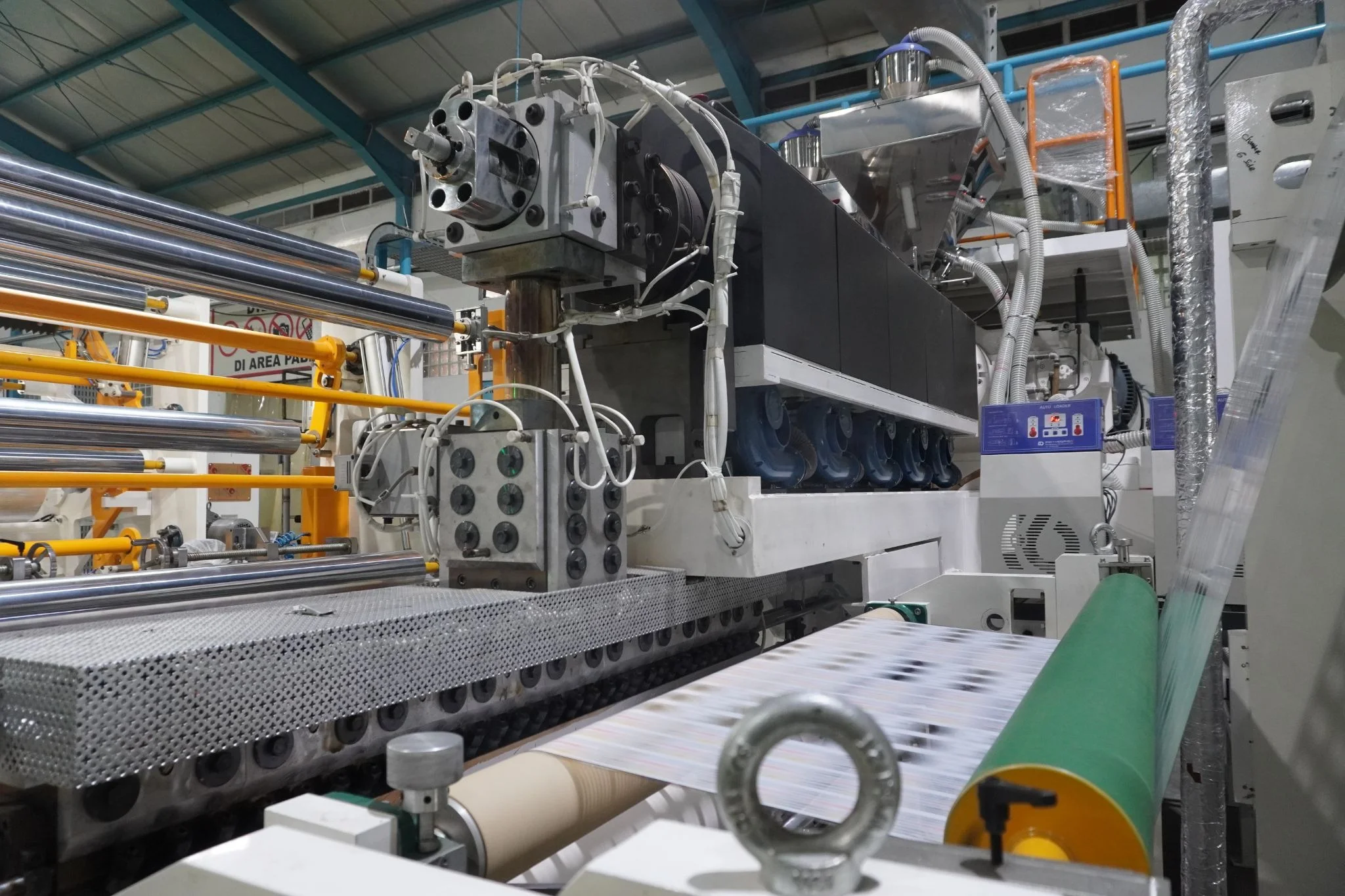
(Source: Documentation of an operating Extruder and T-Die Unit)
|
UNIT |
FUNCTION |
MAIN COMPONENTS |
|
PRIMARY UNWINDER |
Unwinds the primary material, such as printed film, with stable tension. |
Dual-shaft turret, air shaft, dancer roll, ultrasonic diameter sensor, EPC, flying splice. |
|
ANCHOR COATING |
Applies primer so the molten resin adheres to the film. |
Anilox-type coating roll (approx. 175 LPI), NBR rubber impression roll, pneumatic doctor blade, glue pan. |
|
DRY CHAMBER |
Evaporates the primer solvent before the web enters the nip. |
Long chamber with hot air nozzles at 40 to 120 °C; electric heater, heat exchanger, thermal oil, or steam. |
|
EXTRUDER AND T-DIE |
Melts the resin and forms it into a web-width curtain. |
Hopper with automatic loader, screw and barrel, screen changer, feedblock (for co-extrusion), T-die. |
|
UNWINDER SANDWICH |
Unwinds the second material, such as aluminum foil or sealant film. |
Dual-shaft turret, air shaft, dancer roll, flying splice. |
|
LAMINATING UNIT |
Joins the primary material, molten resin, and sandwich material at the nip, then cools it. |
Mirror or matte chrome cooling roll, water-cooled silicone roll and back-up roll. |
|
TRIM EDGE AND SPRAY POWDER |
Cuts off the thick resin edges of the curtain and sprays starch powder on the laminated product. |
Shear or rotary knives, powder sprayer. |
|
REWINDER |
Winds the laminated product into a dense, even roll. |
Dual-shaft turret, dancer roll, touch roll, cutter. |
1. Single Extrusion Lamination
A single extrusion machine uses one extruder and one T-die. The machine produces a single layer of resin, such as LDPE or PP, between two materials.
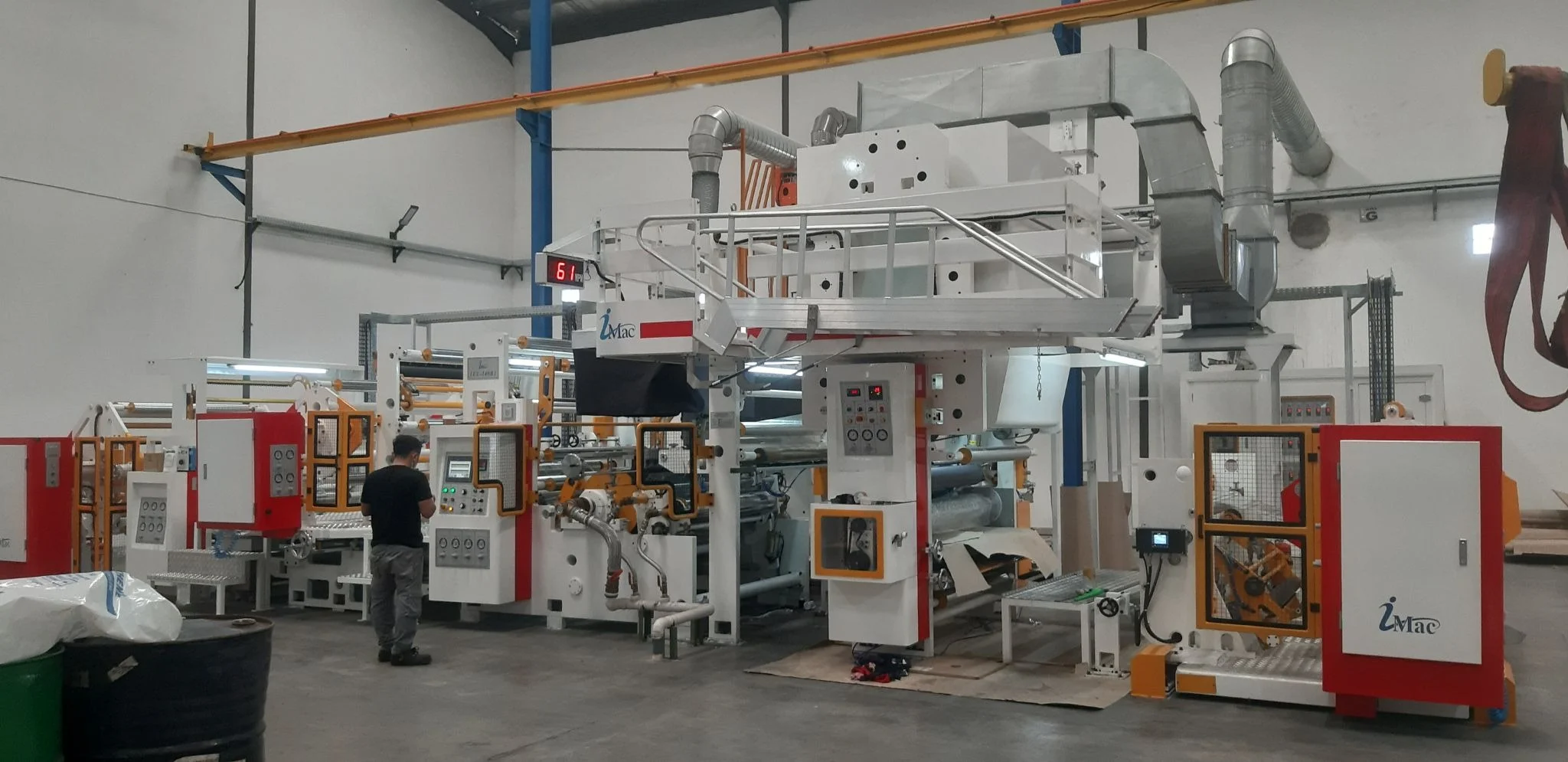
(Source: Documentation of the IEL-140 series Extrusion laminating machine at a client's factory)
The final product remains a multilayer laminate, for example, printed PET film, LDPE, and aluminum foil. The barrier properties come from the aluminum foil or metallized film, meaning a single extrusion machine can produce barrier packaging for food.
- Best for: Film-to-film and film-to-aluminum foil lamination using a single type of resin.
- Limitations: One curtain contains only one resin. If bonding to aluminum foil requires an adhesive resin like EAA, the entire layer must use that resin, which increases resin costs.
2. Co-Extrusion Lamination
A co-extrusion machine uses two or three extruders. Each extruder melts a different resin, and a feedblock stacks the resin streams before they enter a single T-die. The result is a single resin curtain with multiple layers.
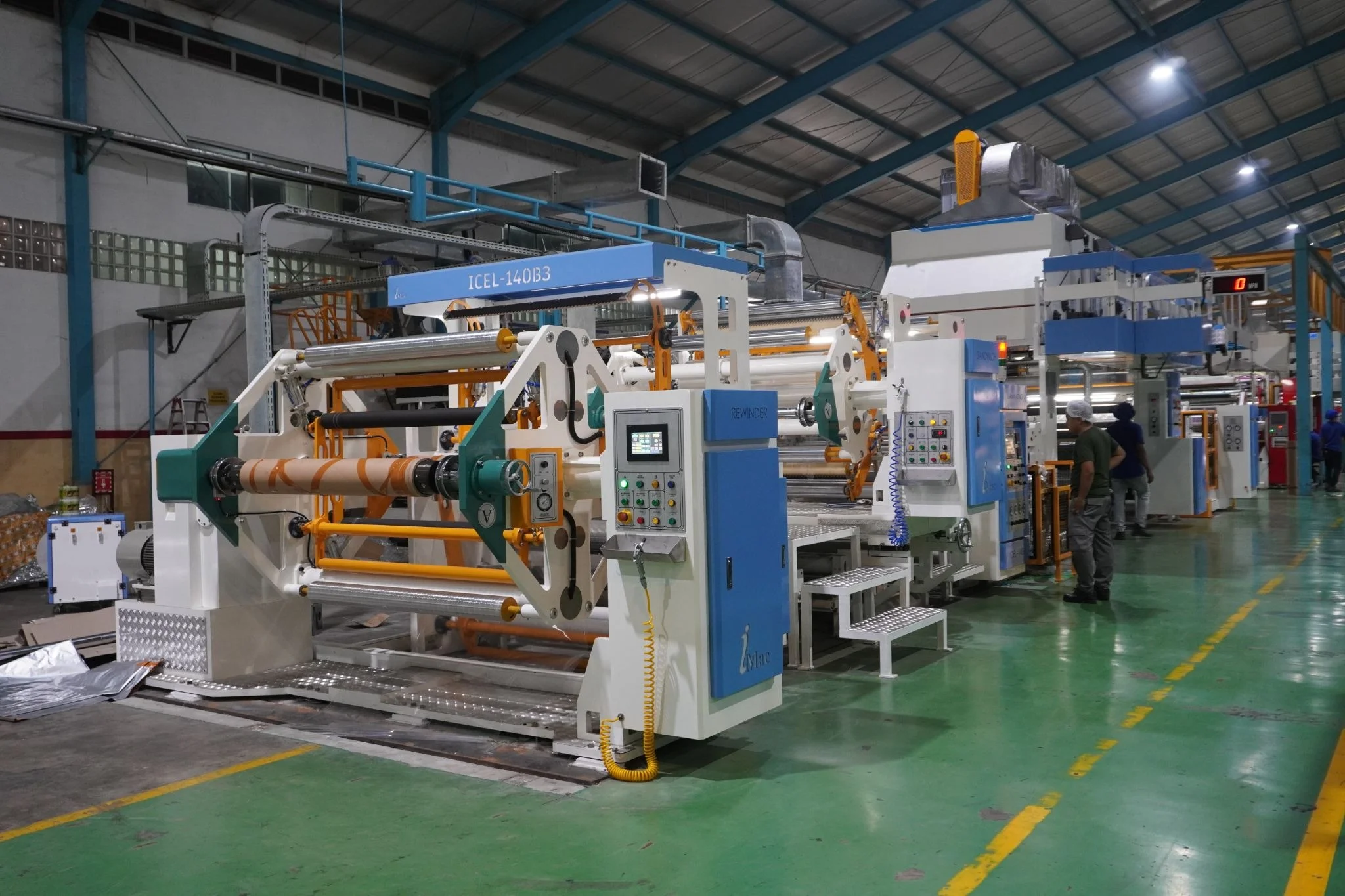
(Source: Documentation of the ICEL-140 series Coextrusion Laminating machine on a client's factory floor)
The layers remain separate because the resin flows in a laminar manner inside the feedblock and die. Operators set the temperature of each extruder so that the melt viscosities between layers match. A large difference in viscosity causes wavy layer boundaries and uneven layer thicknesses.
Operators adjust the thickness of each layer via the extruder RPM ratio relative to the line speed. In auto mode, the extruder RPM rises and falls along with the machine speed, so the layer thickness remains consistent as you increase the speed.
- Best for: Structures requiring two resins within a single lamination layer. For example, EAA on the side adhering to aluminum foil and LDPE on the other side. You achieve a strong bond to the foil while using less adhesive resin overall.
- Limitations: Higher machine investment, and operators must manage multiple extruders simultaneously.
3. Tandem Extrusion Lamination
A tandem extrusion machine installs two extrusion laminating units sequentially in one line. A single pass completes two lamination processes. For instance, bonding printed film to aluminum foil in the first unit, followed by sealant film in the second unit.
With a tandem setup, you save one unwind and rewind process compared to running the lamination twice on a single machine. For certain structures, co-extrusion can replace a tandem setup at a lower cost.
Comparison: Single, Co-Extrusion, and Tandem
|
ASPEK |
SINGLE EXTRUSION |
CO-EXTRUSION |
TANDEM EXTRUSION |
|
NUMBER OF EXTRUDERS |
1 |
2 to 3, one T-die |
Minimum 2, each unit has a T-die |
|
RESIN LAYERS PER CURTAIN |
1 |
2 to 3 |
1 per unit |
|
LAMINATION PROCESSES PER PASS |
1 |
1 |
2 |
|
PRIMARY USE |
Film-to-film and film-to-foil lamination |
Strong foil bonding with more economical adhesive resin usage |
Three substrates in a single pass |
|
SETUP COMPLEXITY |
Simplest |
Medium to high |
High |
How to Choose a Machine Configuration
-
Packaging Structure: Two substrates are sufficient with single extrusion or co-extrusion. Combining three substrates in a single pass requires a tandem setup.
-
Bonding Needs: If you are laminating aluminum foil with an adhesive resin, co-extrusion minimizes the use of that expensive resin.
-
Volume and Budget: Single extrusion is the simplest and requires the lowest capital investment. Tandem extrusion saves on rework processes at high production volumes.
-
Operators: Co-extrusion and tandem setups require operators who are accustomed to managing multiple extruders.
Frequently Asked Questions (FAQ)
1. What is the difference between extrusion lamination and extrusion coating?
Extrusion lamination bonds two materials with molten resin in between them. Extrusion coating coats a single material with molten resin without adding a second material.
2. Can a single extrusion machine produce barrier packaging?
Yes. The barrier properties come from a substrate like aluminum foil. A single extrusion machine laminates printed film with aluminum foil using LDPE or PP.
3. When do I need co-extrusion lamination?
When you need two resins in one lamination layer, for example, EAA to bond with aluminum foil and LDPE on the other side, or when the cost of using a full layer of adhesive resin is too high.
4. What is the difference between co-extrusion and tandem extrusion lamination?
Co-extrusion stacks several resins into a single curtain from one T-die. Tandem extrusion runs two sequential extrusion lamination processes in a single line, allowing you to combine three substrates in one pass.
5. What is the working speed of a co-extrusion laminating machine?
On the Intermac ICEL-140B3, the working speed reaches up to 220 m/min for 15 µm PP over 20 µm BOPP, and 130 to 150 m/min for 30 µm LDPE. The mechanical design speed is 250 m/min. Actual figures depend on the material, resin thickness, and operating conditions.
6. Does Intermac manufacture its own extrusion laminating machines?
Yes. Intermac manufactures extrusion laminating machines at its factory in Bekasi, including the IEL series and the ICEL-140B3 co-extrusion laminating machine. Intermac also provides machine servicing, upgrading, and reconditioning.
Discuss Your Machine Configuration with Intermac!
Intermac manufactures extrusion laminating machines in Bekasi in single, tandem, and co-extrusion configurations. The product line includes the IEL-130, IEL-130S, and IEL-140 with mechanical speeds from 150 to 220 m/min, as well as the ICEL-140B3 co-extrusion laminating machine with a web width of up to 1,300 mm. Over more than 23 years, Intermac has completed over 1,200 projects in more than 10 countries, including Turkey and the Philippines.
Send your lamination structure and the resins you use via WhatsApp. The Intermac team will help you choose a single, co-extrusion, or tandem configuration, and also provides servicing, upgrading, and reconditioning for the machines you currently own.


