
In the flexible packaging industry, the smooth operation of the material travel path (web path) from start to finish relies heavily on the precision of the mechanical components inside the machine. From printing presses (both rotogravure and flexo) and laminating machines to slitting and bag-making units, every machine relies on a series of rotating cylinders or rollers, working in synchronization.
Rollers can be considered the backbone of material movement within the machinery. Dimensional precision, rotational balance, and roller surface condition significantly impact tension stability (film tension). If even a single roller experiences wear, imbalance, or surface damage, the risk of production disruptions, such as material wrinkling, print misregistration, or film snapping (web breaks), increases substantially.
Understanding the function of each roller type along with its surface coating materials helps both production teams and procurement departments maintain machine efficiency and minimize material waste.
Classification of Rollers Based on Function
Every position along the machine line requires distinct roller characteristics. Below are the primary types of rollers commonly found in flexible packaging production lines:
1. Guide Roller (Idler Roller)
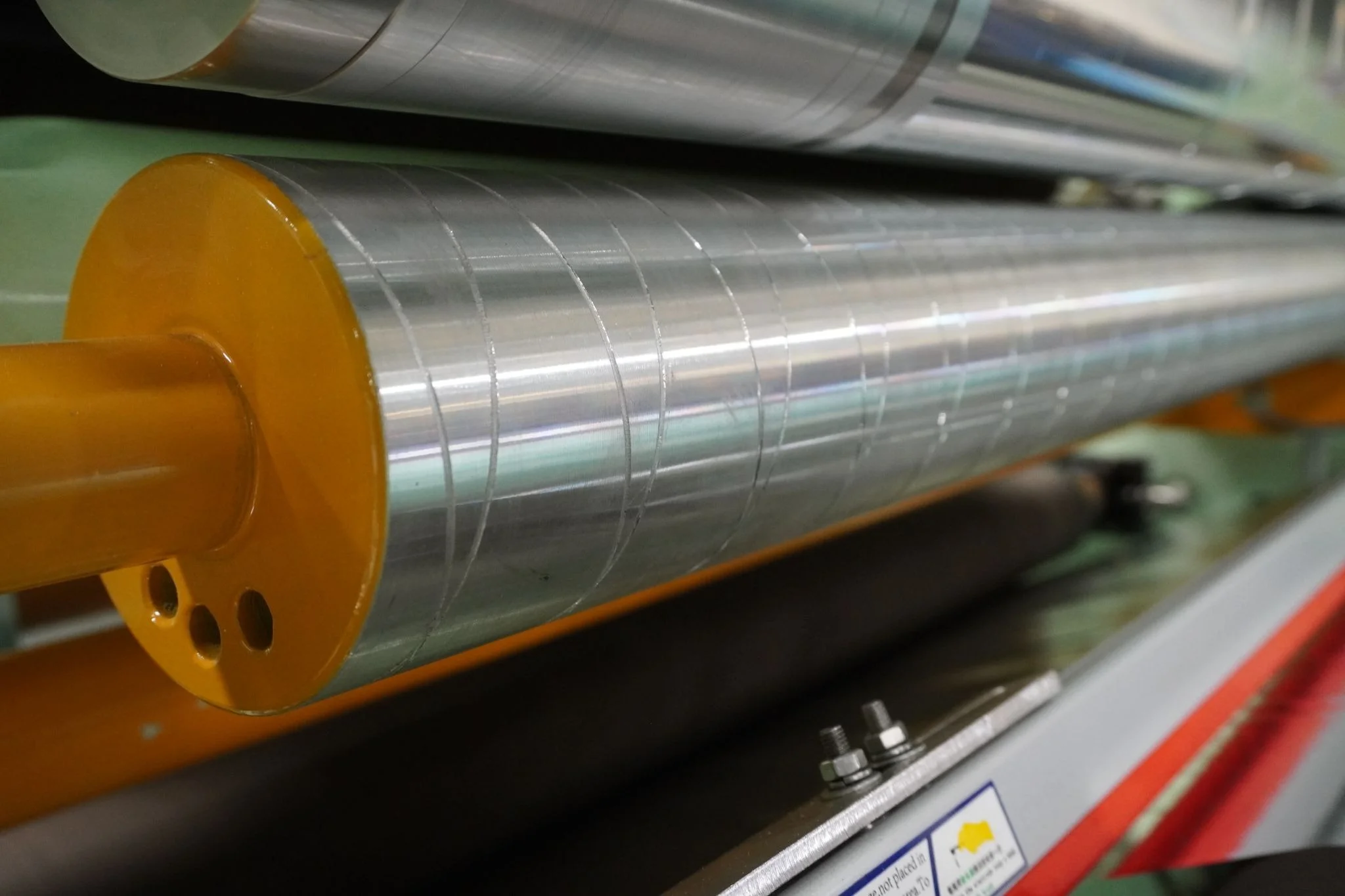
Image: Example of an aluminum guide roller component used to direct the material travel path.
(Source: Photo documentation of a guide roller on a rewinder machine manufactured by International Machinery)
Guide rollers direct, support, and maintain the film web’s travel path so that it remains straight and stable as it moves from one processing unit to another. These rollers are typically non-driven (not powered by the main motor) and rotate freely following the pulling speed of the material. Consequently, guide rollers are generally made of lightweight materials such as aluminum fitted with low-friction bearings to prevent scratching the film surface or adding unnecessary drag to machine tension.
2. Nip Roller (Pressure Roller)
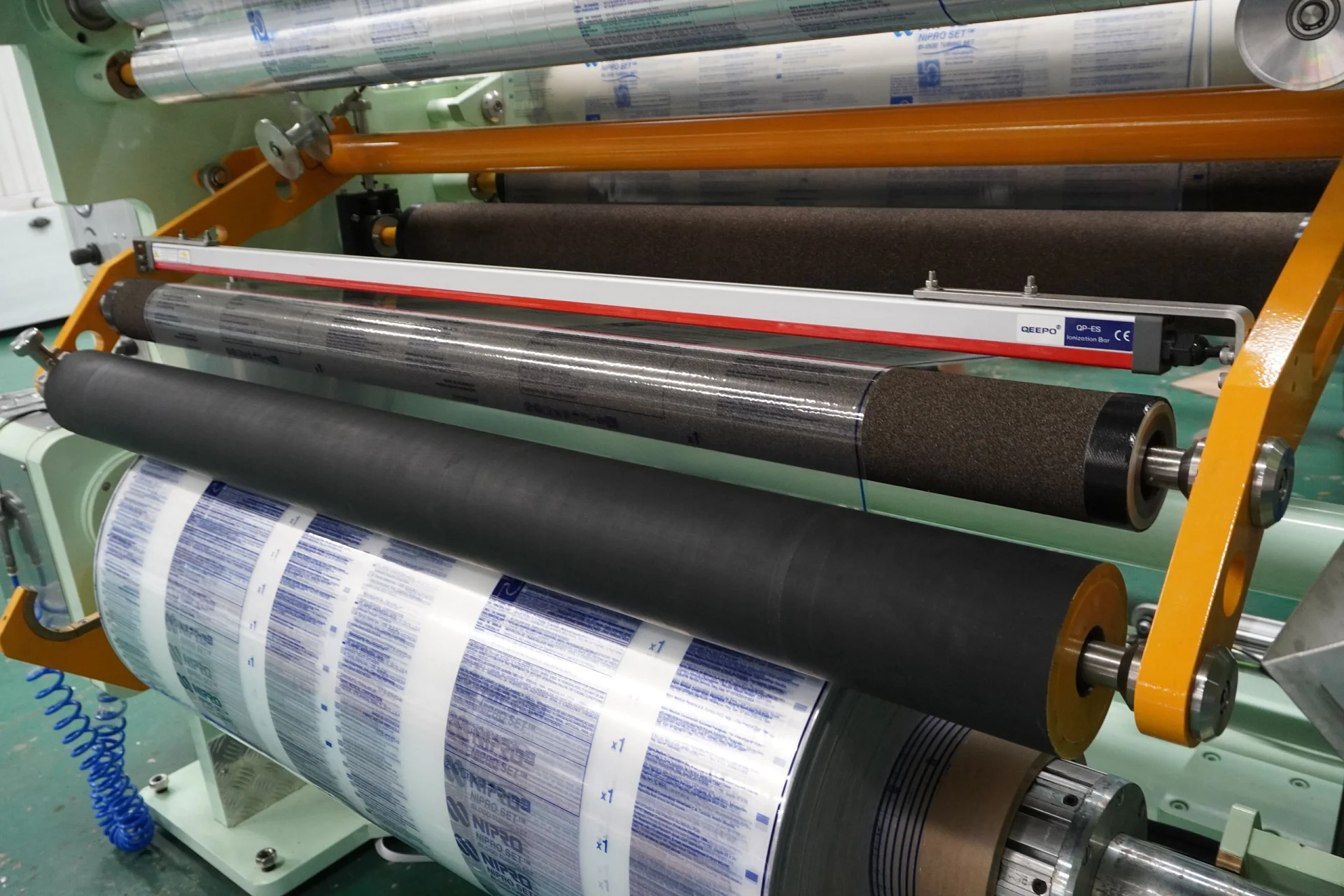
Gambar: Nip roll on Inspection machine which is applying even pressure along the surface of the roll
Sumber: Trial machine documentation on Intermac production floor
Nip rollers operate in pairs alongside another roller, typically a steel roller or a chill roller to apply pinching force (nip pressure). This component is crucial in:
-
Lamination Processes: Bonding two or more layers of film so they adhere evenly without trapping air bubbles.
-
Pull Units (Infeed/Outfeed): Pulling and holding the material to keep speed and tension under control.
-
Sealing: Applying pressure to heated areas in bag-making machines.
Nip rollers are generally rubber-covered with a specific hardness rating tailored to the thickness and characteristics of the plastic film.
3. Spreader Roller
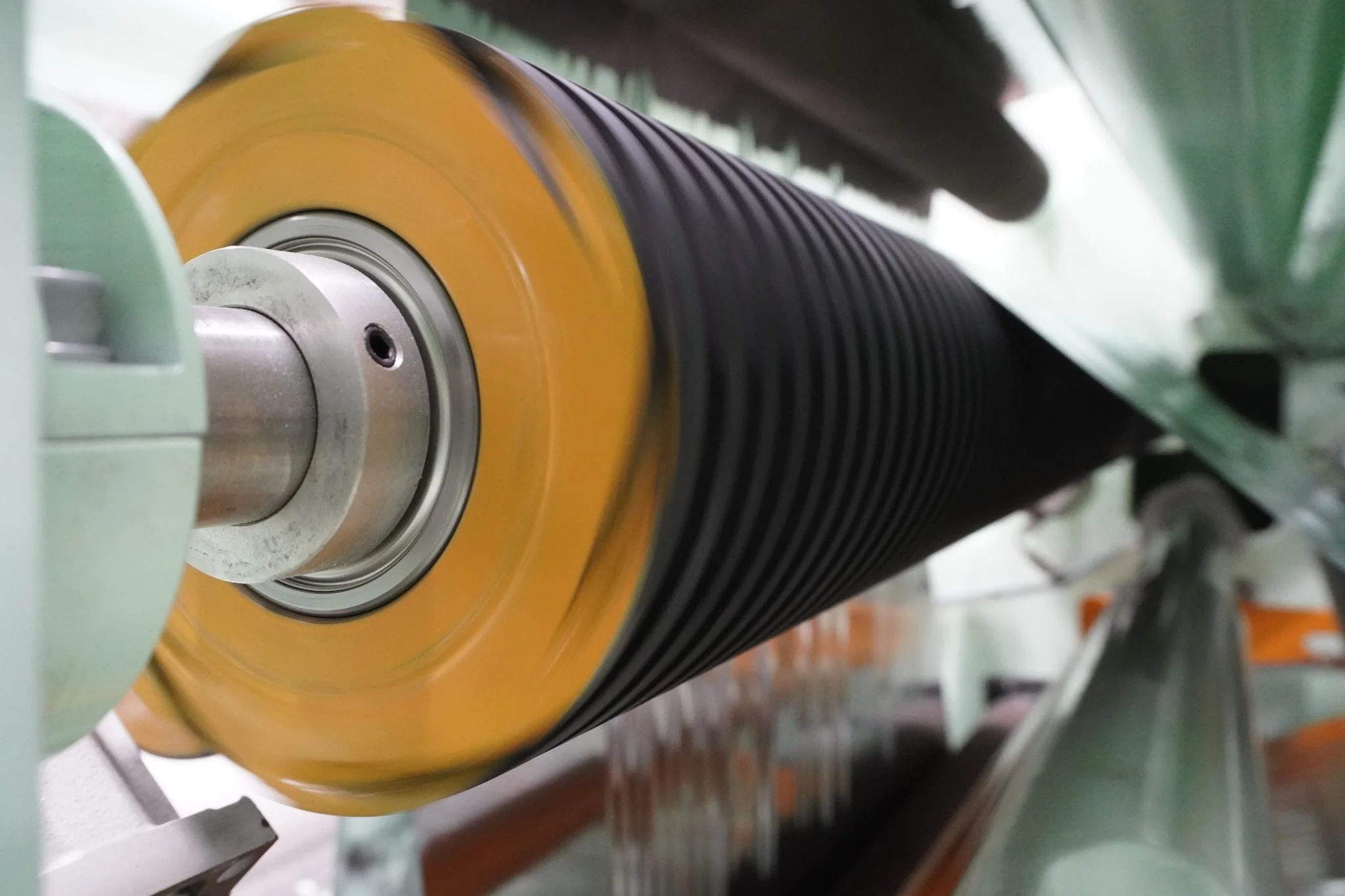
Image: Grooved spreader roller designed to eliminate wrinkles on the film surface.
(Source: Photo documentation of a spreader roller on a rewinder machine manufactured by Intermac)
Spreader rollers stretch the surface of the film material outward laterally in an even manner. These rollers are typically installed right before the material enters critical zones-such as printing units, laminating units, or rewinding sections on slitting machines-to eliminate wrinkles or fine creases in the film web.
There are two main types of spreader rollers:
-
Grooved spreader roller: A roller featuring specialized helical threads or grooves on its surface that push the material outward toward the edges as it rotates.
-
Bow roller / expander roller / banana roller: A curved, banana-shaped roller that spreads the material laterally as the web passes over it.
4. Chill Roller (Cooling Roller)
In production processes involving high temperatures, such as after the material passes through a drying tunnel on a rotogravure press, extrusion laminating, or heat sealing plastic films are prone to thermal expansion or dimensional distortion. Chill rollers are equipped with internal chilled-water circulation channels to rapidly and controllably lower the film's temperature, ensuring the packaging maintains precise shape and dimensions.
5. Dancer Roller
A dancer roller is designed to move up and down or pivot on a mechanical arm. Its function is to absorb sudden fluctuations in material tension, for instance, during roll diameter changes at the unwinder or rewinder units while simultaneously sending feedback signals to the machine's control system (such as a PLC, brake, or servo motor) to keep web tension constant.
6. Anilox Roller
This component is used specifically in flexographic printing presses and coating units. The surface of an anilox roller features microscopically engraved cells of a precisely measured volume. Its function is to hold and transfer ink or adhesive liquids in exact amounts onto the printing plate or directly onto the film surface.
7. Gravure Cylinder (Printing Roller)
In rotogravure printing presses, the gravure cylinder serves as the primary image carrier. Artwork and text designs are engraved directly onto the surface of a chrome-plated metal cylinder; ink fills these engraved cells and is transferred directly onto the surface of the packaging substrate.
8. Corona Treater Roller
Plastic substrates such as PE, PP, or PET naturally have low surface energy, making it difficult for inks or adhesives to bond strongly. A corona treater roller acts as both a support roller and an electrode coated with a dielectric material (such as silicone or ceramic) while the film passes through a high-voltage electrical discharge (corona treatment) to increase the surface adhesion of the film.
Surface Coating Materials and Their Applications
Selecting the right surface coating for a roller determines the component's durability against friction, temperature, and chemicals:
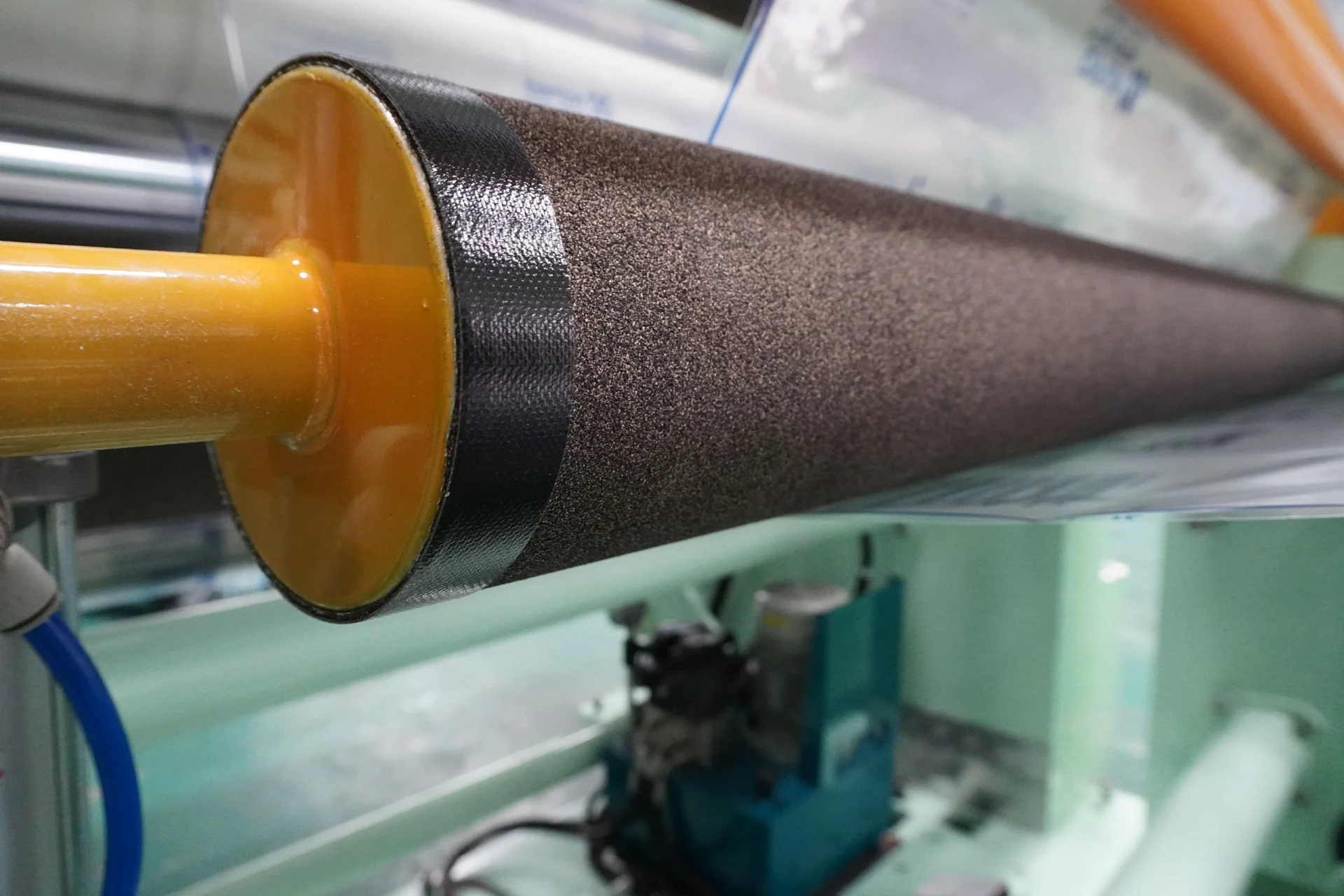
Picture: Example of a roller with a NBR surface coating to prevent film slippage during production.
(Source: Internal Documentation)
-
Rubber Coating (NBR, EPDM, Silicone, Polyurethane): Used to provide grip and uniform pressure without damaging the film. Silicone and EPDM rubbers are typically chosen for high-temperature zones, whereas NBR and Polyurethane offer superior resistance to mechanical abrasion and specific solvents.
-
Hard Chrome & Stainless Steel: Provides an ultra-smooth, hard, corrosion-resistant surface that is easy to clean of residual ink or adhesive.
-
Teflon (PTFE) Non-Stick Coating: Frequently applied to guide rollers positioned immediately after wet ink or adhesive application zones to prevent fluids from sticking and building up on the roller surface.
-
Ceramic Coating: Offers exceptional wear resistance as well as durability against extreme temperatures and high electrical voltage, making it ideal for anilox and corona treater applications.
Key Factors in Selecting and Maintaining Machine Rollers
To ensure optimal machine performance and extend component service life, several technical aspects must be observed:
-
Dynamic Balancing: On high-speed machinery, even the slightest roller imbalance can trigger vibrations that damage bearings and cause film tension to fluctuate. Ensure every roller undergoes dynamic balancing rated for the machine's maximum operating speed.
-
Alignment: Rollers must be aligned with strict parallelism to one another. A roller that is out of alignment by even a few millimeters will cause the material web to drift to one side (web wandering) and induce wrinkling.
-
Proper Rubber Hardness (Shore Hardness): Using a nip roller that is too hard on thin films risks scratching or snapping the web, while rubber that is too soft can reduce the effectiveness of lamination pressure or web traction.
-
Routine Surface Inspection: Rubber surfaces that begin to harden, develop micro-cracks, or wear unevenly should promptly undergo re-grinding or replacement before they lead to high production reject rates.
Summary Table
| Roller Name | Primary Function | Common Materials | Commonly Used On |
| Guide / Idler Roller | Directs and supports the film web path | Anodized aluminum, Stainless steel | All machines (Printing, Laminating, Slitting, Bag Making) |
| Nip / Pressure Roller | Applies nip pressure and web traction | Steel core with rubber cover (NBR, EPDM, Silicone) | Laminating, Slitting, Bag Making, Printing |
| Spreader Roller | Spreads film laterally and removes wrinkles | Specialized rubber cover with a bowed shaft | Slitting, Printing, Laminating |
| Chill Roller | Cools the film after heating processes | Steel with hard chrome plating and water channels | Rotogravure/Flexo Printing, Extrusion Laminating |
| Dancer Roller | Maintains material tension stability | Lightweight aluminum or hollow steel | Unwinder / Rewinder on Slitting, Printing, Laminating |
| Anilox Roller | Precisely meters ink or adhesive | Steel with engraved ceramic coating | Flexo Printing, Solventless/Dry Laminating |
| Gravure Cylinder (Printing Roller) | Primary printing cylinder carrying the image design | Steel/aluminum core with engraved copper and hard chrome layers | Rotogravure Printing |
| Corona Treater Roller | Supports film during surface treatment | Metal core coated with dielectric silicone or ceramic | Printing, Laminating, Extrusion |
Selecting the right machine specifications and roller components is a long-term investment in the smooth operation of a packaging plant. If your company is planning to expand production capacity or requires consultation regarding flexible packaging machinery specifications-from printing and laminating to slitting and bag-making units-contact us to discuss the best solutions for your production line.


