
Converting a jumbo roll into ready-to-use rolls sets your edge quality, your line speed, and the waste figure you absorb every month. Slitting is the process of cutting a large master roll into narrower rolls sized for the process that follows. A slitting machine is a converting machine that pulls, cuts, and rewinds material under precise tension control. Most plants also call it a slitter machine, and both names point to the same equipment.
A machine that does not match your material shows up as downtime, waste, and thinner margins.
How a Slitting Machine Works
Three units carry the process. The principle holds whether you run a plastic film slitting machine for flexible packaging, a paper slitting machine for high-volume printing, or a label slitting machine for the sticker industry.
Unwind unit. Material feeds off the master roll. The task here is holding feed speed steady while the roll diameter shrinks. Modern machines use a pneumatic brake or an AC vector motor, with automatic web guiding (EPC) keeping the web square as it enters the knives.
Slitting unit. Knives separate the web into lanes. Your choice of cutting method sets the edge you get, covered in the next section.
Rewind unit. The unit that demands the most precision. Every material carries small thickness differences across the web (caliper profile), so each roll grows at a slightly different rate. Differential friction shafts absorb that difference by letting each roll turn at a slightly different speed, which holds tension even across all lanes.
Three Cutting Methods
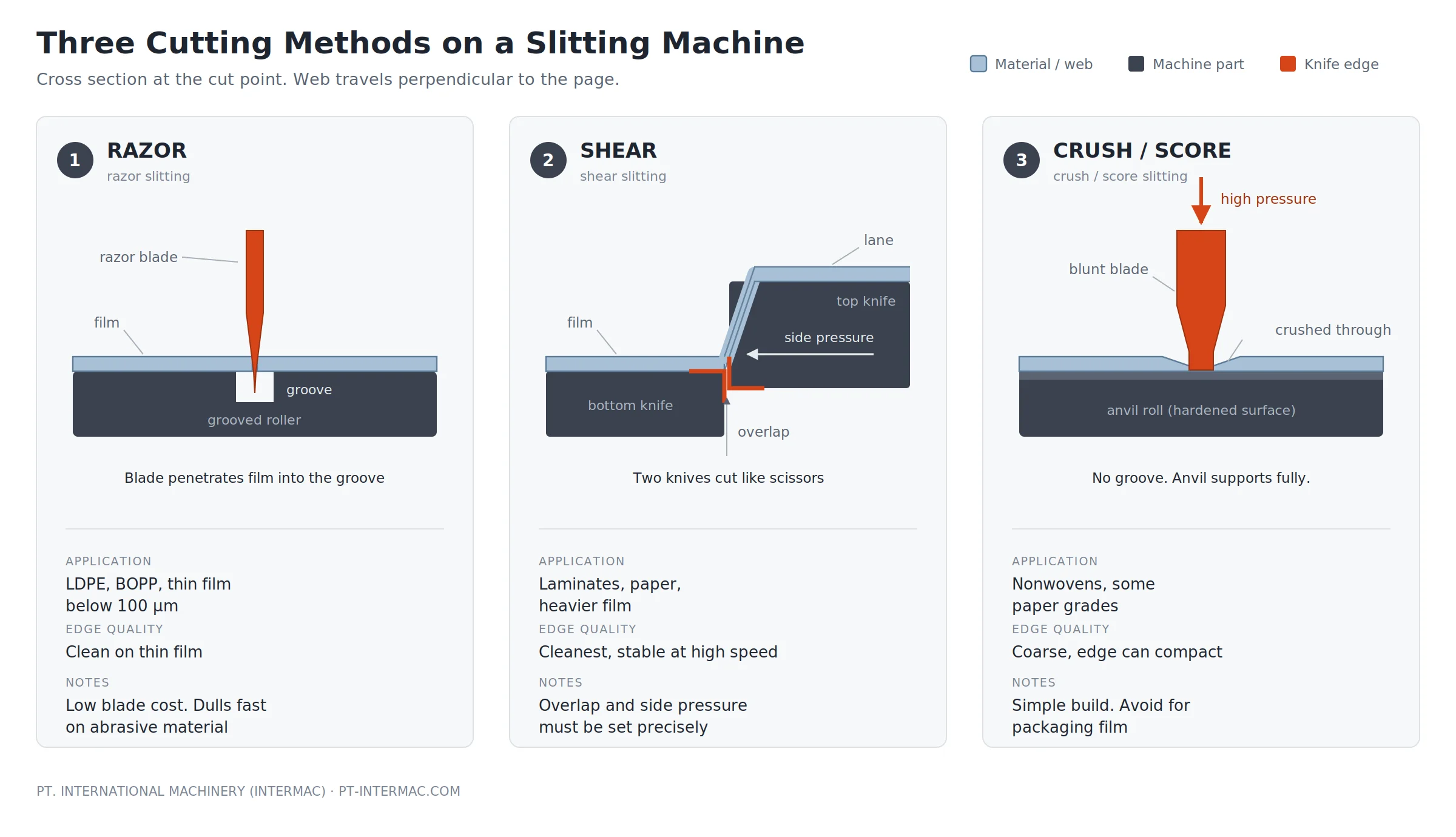
On a flexible packaging line feeding printing or laminating, shear slitting carries the least register risk downstream.
Map Your Production Requirements First
Collect these six figures before you compare any specification sheet:
- Material: BOPP, PET, CPP, PE, OPP, laminates, foil, thermal paper, or specialty substrates. Static behaviour and tension tolerance shift with each one.
- Web width and roll diameter: maximum incoming width, plus the unwind and rewind diameters you need. Machine capacity has to match the jumbo rolls your supplier ships.
- Thickness in microns: thin material calls for finer tension control.
- Target speed and running hours: the metres per minute you hold across a full shift, not a peak number from a spec sheet.
- Number of slits: how many lanes you cut in one pass.
- Edge standard: how clean the cut has to be for the next process.
Tension Control Decides Stability
Flexible packaging material responds fast to any tension change. Check that the machine offers:
- Closed-loop tension control (load cell or dancer) holding tension steady from the first metre to the last.
- Taper tension on rewind, giving you a firm finished roll with no telescoping.
- Web guiding / EPC keeping the web centred through the whole pass.
Match the Rewind System to Your Product
A centre winder gives you flexibility across applications. A surface winder protects surface quality and roll density. A turret rewinder cuts roll-change time, and that pays off on high-volume runs.
Judge the result by the finished roll: hardness, density, edge alignment, and freedom from wrinkles and blocking.
The Points Buyers Skip
Most complaints on the floor trace back to these rather than to machine speed:
- Changeover: blade setting, measuring scales, and repeatability between jobs.
- Safety: blade guarding, emergency stops, interlocks, and lockout-tagout procedure.
- Maintenance: spare part access, greasing schedule, and alignment work.
- Component quality: bearings, shafts, motors and drives, sensors, and controllers that hold accuracy over years.
- After-sales support: European machines bring advanced technology, and a spare part lead time running into months can stop your line.
Fit with the Next Process
A good slitting machine serves what comes after it. A clean edge prevents register problems on the printing press. A round, firm roll prevents slippage during lamination. Consistent slit width cuts setup time on the bag making machine.
Supplier Discussion Checklist
- Which materials can you trial on the actual machine?
- What are the minimum and maximum slit widths, and the guaranteed tolerance?
- How are tension control and web guiding configured?
- How long does a changeover take for knives, cores, and job settings?
- Is operator training included?
- What is the spare part availability and service SLA?
Intermac Slitting Machines (ISL Series)
For plants operating in Indonesia, local engineers and local spare parts remove the risk of a long stoppage. PT International Machinery (Intermac) has built converting machines in Bekasi, Indonesia since 2002, to global standards with service on the ground. Our record covers more than 1,200 projects, including work for Indofood, Mayora, Wings, and Amcor.
| Model | Web Width | Max Speed | Optimal Application |
|---|---|---|---|
| ISL-60H | 500 mm | 200 m/min | Laminated film 100-400 µm, mid-size converting |
| ISL-130M | 1,250 mm | 450 m/min | High-speed production with dual differential shafts |
| ISL-140H | 1,300 mm | 450 m/min | Wide-web high throughput converting |
| ISL-150H | 600-1,400 mm | 500 m/min | Heavy-duty converter workhorse, high flexibility |
| ISL-180SF | 700-1,300 mm | 500 m/min | Ultra-high precision slitting with unwinder up to Ø1,300 mm |
Every ISL machine runs razor, shear, or rotary knives to suit the application, with automatic tension control on AC drives or servo drives.
Reconditioning and Modernisation
When a new machine is not yet on the budget, we recondition and modernise the machines you already run. We replace analogue controls with current PLC and HMI systems, adding years of service life at a fraction of new-unit cost.
Talk to a Machine Specialist
Bring us your capacity requirements, your materials (plastic film, paper, aluminium foil), and any repair or reconditioning needs, and speak with our machine specialists.
Contact Intermac Engineering for Technical Consultation:
PT. International Machinery (Intermac)
Jl. Raya Narogong KM 12, Pangkalan 2 No. 25, Cikiwul, Bantar Gebang, Bekasi, West Java, Indonesia
+62-21-82607020 | halo@pt-intermac.com | www.pt-intermac.com


